
Why Patients Drop Out Before Session Three (And How To Fix It)
If you’ve got patients dropping out of treatment plans before session three, there’s a good chance you’ve got a communication problem.
And more specifically, there’s a good chance your physios aren’t getting session one right.
I’ve trained a lot of physiotherapists over the years, and one thing I’ve found is that most are actually pretty good clinically. They can take a subjective history. They can perform an objective assessment. They can work out what’s going on and usually have a pretty good idea of how they’re going to treat it.
But it’s what happens next where things often fall apart.
They get to the end of the assessment and struggle to take everything they’ve found and communicate it in a way that the patient understands, believes in and wants to commit to.
This is a much bigger problem than most clinic owners realise. Because when a patient leaves that first appointment without understanding what’s wrong, why it’s happening or what the plan is, there’s a good chance they won’t come back.
The Three Problems With Getting Session One Wrong
1. The Patient Loses Out
They’ve come to your clinic because they’ve got a problem they want solving. But they leave feeling unsure.
They’re sceptical about whether treatment is going to work, they don’t really understand what’s causing their symptoms, and they haven’t got a clear plan.
So they disengage. They don’t complete their treatment, and potentially they’re still left dealing with the same problem.
2. Your Clinic Loses Money
Think about everything you’ve invested in getting that patient through the door: your website, advertising, marketing, team, facilities and equipment.
You’ve done all the hard work to generate that patient. And now they’ve disappeared after one appointment.
If this happens occasionally, it’s frustrating. If it’s happening consistently across multiple clinicians, it’s costing your business an absolute fortune.
You’re constantly having to generate more and more new patients just to replace the ones you’re losing. And for many clinics, this is one of the biggest barriers to growth.
3. Your Physios Miss Out On Valuable Clinical Experience
This is the part people often overlook.
When clinicians aren’t seeing patients through complete treatment journeys, they’re missing out on valuable clinical repetitions. They’re not seeing how conditions respond over time. They’re not learning when to progress treatment, when to change direction or how to manage patients through more complex rehabilitation.
And ultimately, that slows down their development as physiotherapists.
So everybody loses. And very often, the problem comes back to one thing: not getting session one right.
How I Train My Physios To Get Session One Right: The CLOSE Framework
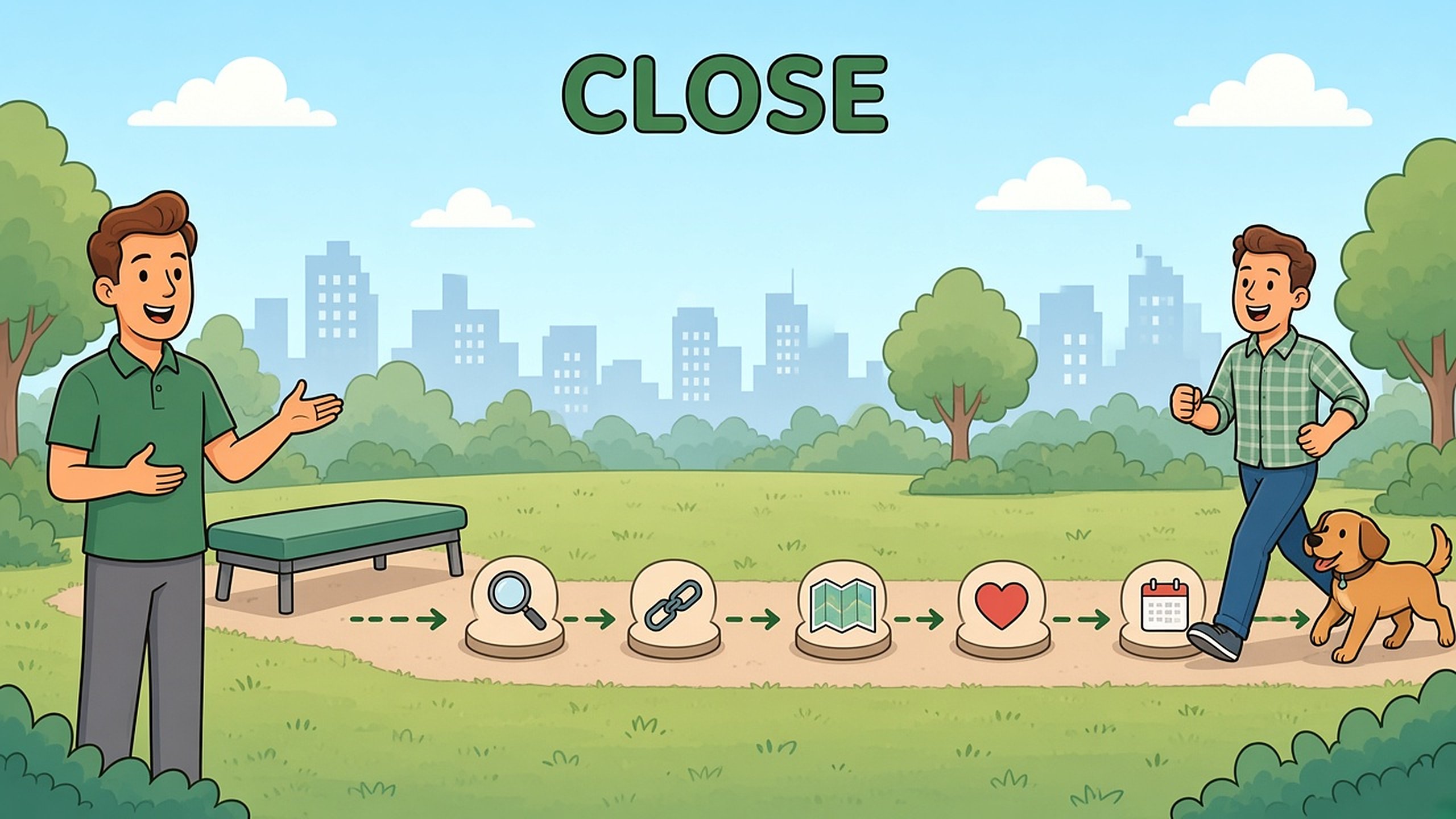
One of the frameworks I’ve used for years when training physiotherapists is called CLOSE.
It’s a simple, repeatable structure that helps clinicians communicate their findings and recommendations at the end of an initial assessment.
Because it’s not enough to know what’s wrong with somebody. And it’s not enough to know how to treat them. You’ve got to be able to communicate that knowledge in a way the patient understands and has confidence in.
Here’s how it works.
C: Confirm The Problem
Start by explaining what you believe is wrong with the patient.
Give them a proper clinical diagnosis wherever possible, but make sure you explain it in language they actually understand.
Remember, the patient hasn’t come to your clinic for an anatomy lesson. They want to know what’s wrong with them.
L: Link The Findings
This is probably my favourite part of the framework, because this is where you create that lightbulb moment.
Let’s say you’ve got somebody with lower back pain. During your assessment, you’ve identified that their straight leg raise is restricted to around 45 degrees.
You could simply record that in your notes and move on.
Or you could explain what you’ve found. Show the patient that they’re only getting to 45 degrees when you’d ideally like to see them getting closer to 90. Then explain that this restriction in movement through their hips and hamstrings could be contributing to the problem. When they bend forwards, they may be compensating by taking more movement through their lower back, potentially aggravating their symptoms.
Now, that’s not to say a restricted straight leg raise automatically causes back pain. Your findings need to be clinically relevant.
But when you can demonstrate a meaningful finding and explain how it relates to their symptoms, suddenly the patient starts to understand.
And that’s the difference between simply telling somebody what’s wrong and helping them understand why.
O: Outline The Plan
This is where productisation comes in.
One of the things I teach clinic owners is to stop selling individual physiotherapy appointments. Your patients don’t want another 45 minutes of physiotherapy. They want to get back to running, playing golf, going to the gym or picking their grandchildren up without pain.
So explain how you’re planning to get them there:
- How many appointments do you anticipate they’ll need?
- How frequently should they attend?
- What are the stages of treatment?
- What are you trying to achieve?
Obviously, every treatment plan needs to be clinically appropriate and agreed with the patient. But leaving somebody with the impression that they should just book another appointment if they feel they need one isn’t much of a plan.
S: Sell The Why
This is where a lot of clinicians really struggle. Because explaining what treatment you’re recommending isn’t the same as explaining why the patient needs it.
Imagine you’ve got a runner with Achilles pain. It’s stiff first thing in the morning, painful at the start of their runs, but once they’ve warmed up, they can usually get through their training.
From their perspective, the problem isn’t that bad. So why should they commit to treatment?
This is where you need to explain why addressing the problem now matters. If they continue to overload the tendon without managing it properly, there’s a risk their symptoms could become more limiting and eventually affect their ability to run.
You’re not trying to scare them. You’re helping them understand the potential consequences and linking those consequences to something they actually care about.
E: Establish The Next Step
Finally, make the next step incredibly simple.
If you’ve recommended six sessions of shockwave therapy, explain when they should attend and how the treatment will progress. Then give them one clear action. Perhaps that’s heading to reception and booking their appointments a week apart.
Whatever it is, they should leave knowing exactly what happens next.
That’s CLOSE. And when you get it right, the patient should leave feeling listened to, understood, clear on what’s going on and confident that they’re in the right place.
Why A Framework Alone Isn’t Enough
Here’s where clinic owners get it wrong.
They assume that because they’ve explained a framework to their clinicians, they’ll suddenly start using it. They won’t.
Communication is a skill, and skills need training.
When I’m training my physiotherapists, we spend a lot of time roleplaying these conversations. I’ll play the patient, they’ll play the clinician, and we’ll practise closing different clinical scenarios.
And it’s amazing how often a clinician who understands the problem perfectly well struggles to explain it clearly to somebody else. That’s why you need to practise.
Use Your Clinical KPIs To Spot The Problem
You also need to understand your clinical KPIs.
If you’ve got a clinician with a particularly low patient visit average, a high cancellation rate or patients consistently disappearing before session three, I’d want to know why.
It doesn’t automatically mean they’re a poor communicator. But it’s certainly something I’d investigate, and one of the first things I’d look at is how they’re closing their initial appointments:
- Are they explaining the diagnosis?
- Are they linking their findings?
- Are they outlining a clear treatment plan?
- Are they explaining why that treatment matters?
- Are they establishing the next step?
Once you’ve identified where they’re struggling, you can actually start coaching them.
You Might Not Have A Marketing Problem
Before spending more money trying to generate new patients, have a look at what happens to the patients you’re already generating.
Because if you’re losing them after one or two appointments, you might not have a marketing problem at all. You might have a communication problem.
And fixing that could be one of the most profitable things you do in your clinic.
Want To Learn More?
I’ve put together a full YouTube video walking you through exactly how I use the CLOSE framework to train my physiotherapists, with practical clinical examples and advice on improving patient engagement and retention.