
Worried About Staff Leaving?
I had a call with a clinic owner recently and I could tell he was really anxious about the thought of staff leaving.
He was trying to grow the business, reinvest, improve things and move forward, but at the same time a few physios had started asking him for pay rises and he felt like he had to say yes because he was worried that if he did not, they might leave.
That is a really difficult position to be in as a business owner, but the thing I said to him was that the problem is not actually the problem.
The issue is not really that one physio has asked for more money, or that you now feel under pressure to give them a pay rise.
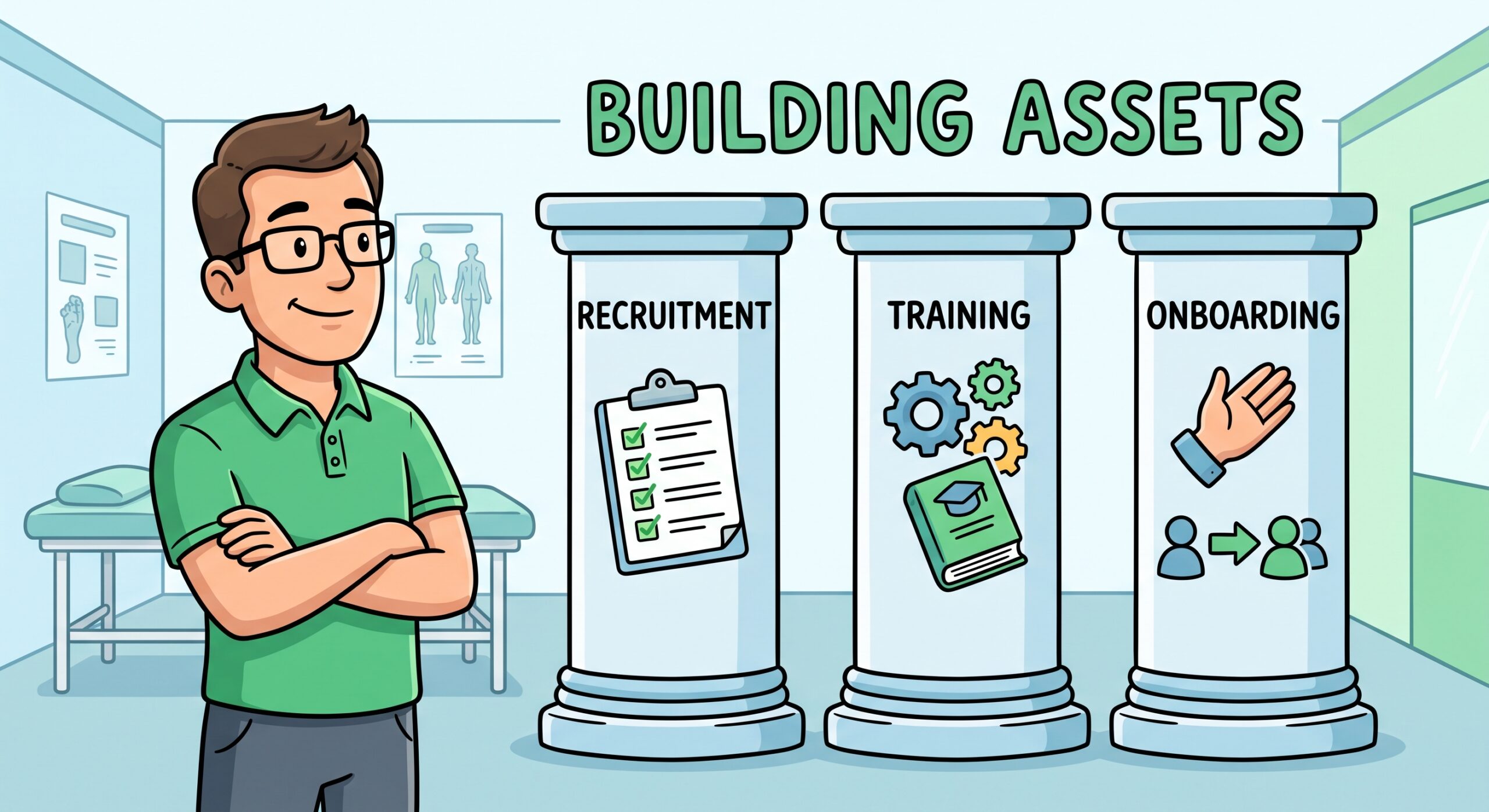
The deeper issue is that the business has asset deficiencies around recruitment, training and onboarding.
Build a Recruitment Asset
If one person leaving creates panic, then you probably do not have enough recruitment assets in place.
You should have a pool of physios in your local area that you already know, have spoken to or can contact quickly whenever an opportunity comes up, rather than starting from zero every single time somebody hands their notice in.
You should also have a recruitment process that is proven and repeatable, so that when you do need someone, you already know how you are going to find them, contact them and move them through the process.
Build Training and Onboarding Assets
The same applies to training and onboarding.
If a member of staff leaves and your first thought is that it is going to take months to replace them and get somebody new up to speed, then that tells you there is probably another asset missing.
You need a system that allows you to bring somebody in, onboard them properly, train them quickly and get them up to the standard you need without the whole thing relying on you personally.
Once those assets are in place, staff leaving can still be inconvenient, but it does not need to feel frightening.
More importantly, it means you stop making decisions from fear.
You are not giving pay rises because you feel trapped, and you are not holding on to people purely because replacing them feels too difficult.
You can make decisions based on what is actually right for the business.
Sometimes Your Staff Are Right
There is another side to this though, because sometimes your staff are right.
Sometimes they are right to ask for a pay rise and, in some cases, they probably are not being paid what they are worth.
That might mean the issue is not your recruitment pipeline at all. It might mean your remuneration structure needs looking at, because you have never properly worked out what good performance should be worth or how somebody’s pay should progress as they create more value.
The danger comes when you start handing out pay rises without understanding the numbers behind them.
Imagine your clinic normally runs at a 30 percent profit margin and you have a long standing member of staff who is already 85 percent full.
There is only around 15 percent of capacity left to create additional revenue from that person, so if you then give them a significant pay rise without anything else changing, you can very quickly crush the profitability of that individual.
That does not mean they should not get the rise.
It means you need to understand whether their pay reflects the value they bring into the business and whether the structure still works commercially.
Stop Making Decisions From Fear
The biggest mistake is making either decision from fear.
Do not automatically say no because you are trying to protect margin, but equally do not automatically say yes because you are scared somebody might leave.
If you notice that you are feeling trapped, anxious or overly dependent on one person, recognise that feeling for what it is.
There is probably an asset missing somewhere in the business.
Your job as the entrepreneur is to identify exactly what that missing asset is and then build it.
It might be a recruitment pipeline, a better onboarding system, stronger training or a clearer remuneration structure.
How We Do This in PhysioLeads
In my own clinics, a lot of these assets now sit inside PhysioLeads.
We have always open application forms, which means physios can apply even when we are not actively recruiting.
PhysioLeads then tags and stores those applicants, so if a vacancy suddenly appears, we are not scrambling around wondering where to find somebody.
We already have a pool of physios we can contact very quickly through email and SMS.
The same applies to onboarding and training.
When somebody joins us, we can simply add the relevant tag to their name and they automatically get access to the training they need.
That can include everything from KPIs and expectations through to clinical assessment material, communication training and the systems we use inside the clinics.
So recruitment, onboarding and training are no longer things that just live in my head or depend on somebody remembering what to do.
They have become assets inside the business.
Find the Missing Asset
That is ultimately the game.
Whenever you feel a part of the business becoming fragile, dependent or stressful, ask yourself what asset is missing underneath it.
Then build it.
If you cannot build it yourself, find the very best person you can to help you build it, put it into the business and move on to the next constraint.
That is how you gradually create a business that is less dependent on individual people and less likely to force you into decisions made from fear.
And if recruitment, onboarding and staff training are some of the gaps in your clinic, that is exactly the type of thing we have built PhysioLeads to help with.
Joe